What are Black Holes?
Black holes are regions of spacetime where gravity is so strong that nothing—not even light or other electromagnetic waves—can escape once past the event horizon. They are among the most fascinating and mysterious objects in the universe, predicted by Einstein's theory of general relativity and now observed directly through gravitational wave detection.
Massive Stars
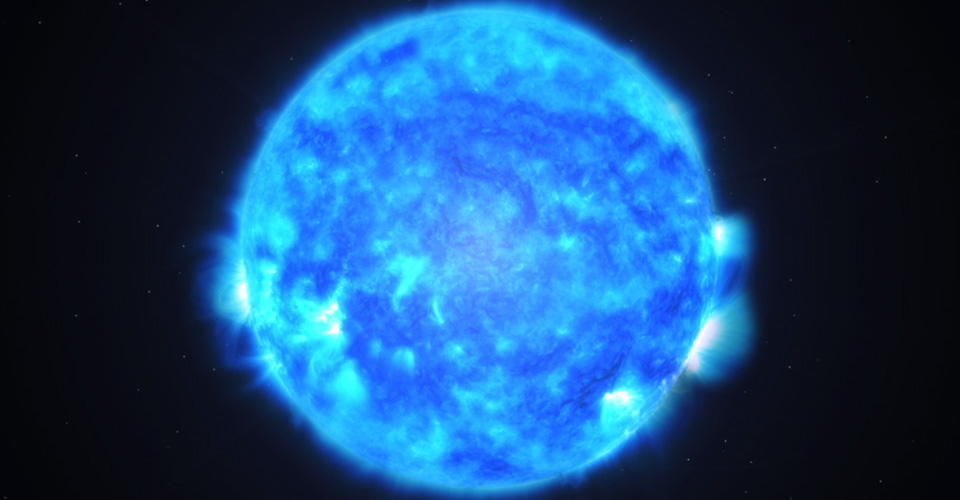
The story of stellar mass black holes begins with massive stars—stellar giants that are at least 8 times more massive than our Sun, with the most extreme reaching over 100 solar masses. Unlike our Sun, which has a lifespan of billions of years, these cosmic powerhouses burn through their nuclear fuel at prodigious rates, living fast and dying young—often in just millions of years.
In their cores, these stars fuse elements in an "onion-layer" sequence: hydrogen to helium, then carbon, and so on. This process creates immense energy that supports the star against gravity. However, once iron accumulates in the core, the fusion stops releasing energy. This triggers a catastrophic collapse, often resulting in a brilliant supernova explosion that leaves behind either a neutron star or, if massive enough, a black hole.
Stellar Mass Black Holes
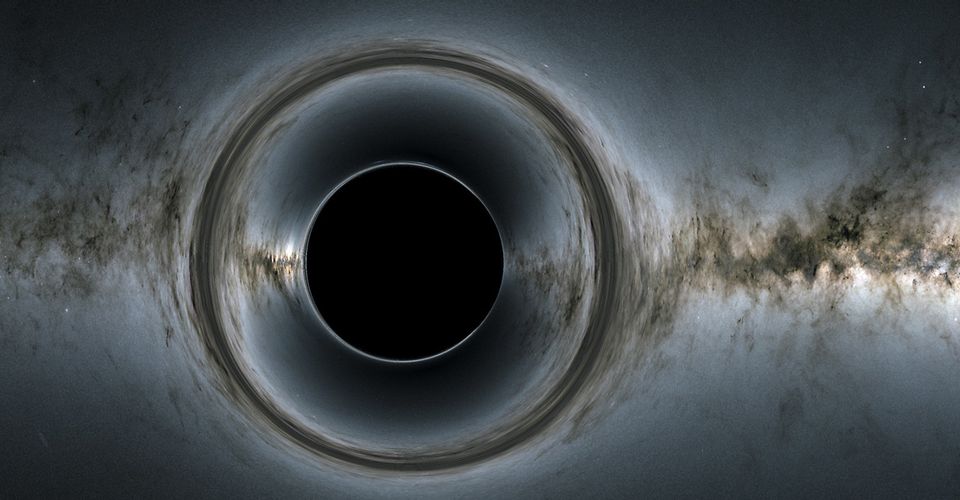
When a star more than 20 times the mass of our Sun ends its life, the core collapse is effectively unstoppable. If the remnant core exceeds roughly 3 solar masses, not even neutron degeneracy pressure can halt gravity. The object collapses to a point of zero volume—a singularity—surrounded by an event horizon.
Stellar mass black holes typically range from 5 to 100 solar masses. Since they emit no light of their own, we detect them indirectly: either by observing their gravitational influence on a companion star or by detecting the X-rays emitted as they devour nearby matter. The size of the event horizon scales linearly with mass; a 10-solar-mass black hole has a radius of just ~30 kilometers.
Binary Black Hole Systems
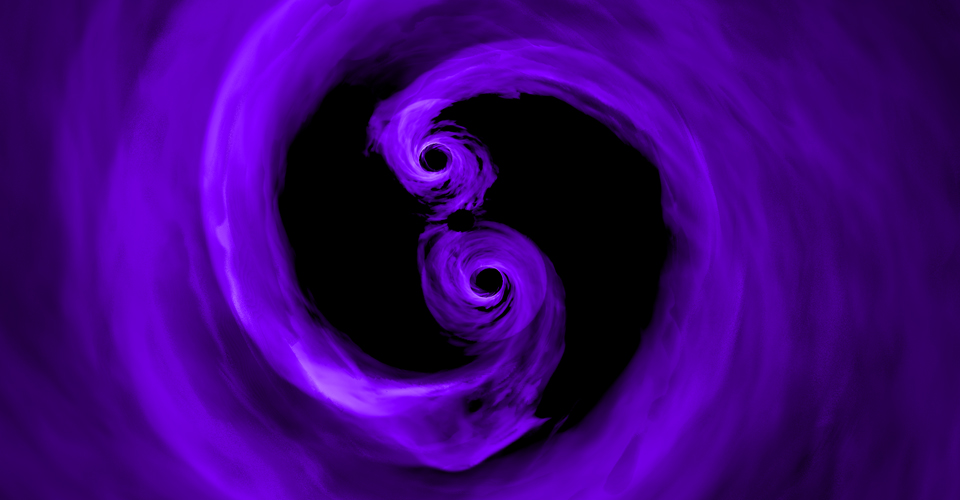
Often, black holes are not alone. A binary black hole system consists of two black holes orbiting their common center of mass. These pairings can arise through isolated binary evolution, where two massive stars in a binary system both transform into black holes, or through dynamical formation, where black holes in dense environments (like globular clusters) capture one another gravitationally.
Once bound, the pair is doomed to spiral inward. As they orbit, they disturb spacetime, emitting gravitational waves that carry away orbital energy. This loss of energy causes the orbit to shrink and the black holes to speed up, leading to an inevitable collision. In some cases, the product of a merger can find yet another partner, leading to hierarchical growth of even larger black holes.
Black Hole Mergers
When the black holes finally touch, the event is cataclysmic, briefly releasing more power than all the stars in the observable universe combined. The merger unfolds in three distinct phases:
- Inspiral: The black holes spiral closer at increasing speeds, churning up spacetime and emitting intense gravitational waves.
- Merger: The event horizons touch and coalesce into a single, peanut-shaped, highly distorted black hole.
- Ringdown: The new, larger black hole vibrates like a struck bell to shed its distortions, settling into a stable, quiet state.
Crucially, mass is not conserved in this process. Around 5-10% of the total mass is converted directly into energy (E=mc²) and radiated away as gravitational waves, leaving the final black hole lighter than the sum of its parents.
Gravitational Waves
The ripples tracked by our detectors—gravitational waves—move at the speed of light, stretching and squeezing the fabric of reality itself. Unlike light, which can be blocked by dust, these waves pass unimpeded through matter, carrying pristine information from the heart of the merger.
We catch these faint signals using a global network of kilometer-scale interferometers. LIGO (USA) made the historic first detection in 2015. It is joined by Virgo (Italy) and KAGRA (Japan), creating a planet-sized "ear" to the cosmos. In the future, the space-based LISA mission will detect low-frequency waves from supermassive black hole mergers, opening yet another window onto the dark universe.
Why This Matters
The study of black holes and gravitational waves opens new windows to the universe. It helps us understand stellar evolution, test general relativity in extreme conditions, and explore the fundamental nature of spacetime. This is an exciting time for astrophysics, with each new detection revealing more about these cosmic giants.